
Home vs. Office vs. Streaming: Matching Gaming Chair Specs
A home console corner, a home office desk, a live streaming studio and an internet cafe floor place four different sets of demands on the same product category. This guide shows which chair specifications each environment actually drives, and how published models — including MC196-3-1, MC1034, MC196-1, MC1039 and MC1040 from Anji Maochang Furniture Co., Ltd. — line up against each setup.
The term “gaming chair” describes a silhouette, not an operating condition. A chair that lives in front of a home console is used by one person, for a few hours, in a dim room. A chair on an internet cafe floor is used by dozens of people a week, wiped down daily and purchased in volume. A chair behind a streaming setup sits in front of a camera and lighting for hours at a time, where its backrest is part of the picture. A chair bought for a home office has to survive a full working day and then the evening that follows it.
Because the environments differ, the specifications that decide whether a chair succeeds also differ. The sections below separate those environments, explain which specification answers each one, and then match verified model data to the setups it supports.
Why One Specification Sheet Cannot Cover Four Environments
Most gaming chair product pages publish a single block of data: product size, carton size, loading quantity, material and mechanism. That block is complete for logistics and almost silent on suitability, because the same numbers answer different questions in different rooms.
Six variables change between home, office, streaming and cafe use, and each one moves independently of the others:
- Seated hours per day. A home console player may sit for two to four hours in an evening. A home office user may occupy the same chair for a full working day and then stay in it for personal use afterwards. Long, continuous sessions raise the importance of sustained posture support and of foam that recovers its shape.
- Users per chair. Home setups serve one owner who adapts to the chair. A cafe floor serves many users of different heights, which pushes adjustment range — especially seat height and armrest height — to the top of the requirement list.
- Cleaning frequency and surface wear. A home office chair may be wiped occasionally. A cafe chair is cleaned far more often, and high-traffic surfaces are where cover material, seam construction and foam density are tested first.
- Visibility. Streaming exposes the backrest and headrest to a camera for hours. The chair becomes part of the on-screen composition, and covers that look acceptable in a dim room show wear faster under continuous studio lighting.
- Compliance exposure. A chair placed in an institutional office environment in the EU is judged against office work chair standards, while a chair sold into the UK upholstery market has to consider fire performance requirements. Home buyers rarely ask for test reports; office, cafe and streaming buyers frequently do.
- Purchase and replenishment pattern. A single home chair is a one-off purchase. A cafe or streaming studio order is a batch that must be repeatable, with a predictable lead time and a stable carton and loading configuration.
The practical consequence is straightforward: a buyer comparing two chairs feature by feature learns very little, while a buyer comparing two chairs against a single environment profile reaches a decision quickly. The environment should be defined before the specification, not after.
Industry Background: Where the Category Stands Now
Published third-party market research places the global gaming chair market at approximately USD 1.37 billion in 2024, with a projected value of about USD 2.05 billion by 2030. North America accounted for a 36.4% revenue share in 2024 and remains the largest regional market.
Three product-level data points matter for the environment-matching discussion in this article. PC gaming chairs hold a 52.6% product segment share as of 2024, which confirms that desk-based setups remain the dominant use case. PU leather is the most common cover material, holding a 57.3% market share in 2024, which matters because cover choice drives cleaning and wear behaviour. And hybrid “work-and-game” chairs hold a 29.8% share as of 2024 — the clearest available signal that home office and personal gaming use are converging into one chair in the same room.
On the supply side, the Anji furniture cluster in Zhejiang Province, China is described in trade data as the world’s leading production base for gaming chairs, contributing to China’s 30.8% share of global furniture exports. Anji Maochang Furniture Co., Ltd. is a chair factory located in Anji County, Zhejiang Province, established in 2016.
Standards shape the compliance side of the same decision. ANSI/BIFMA X5.1 is the primary safety and durability standard for general-purpose office and gaming chairs in North America. EN 1335 is the European standard for office work chairs, covering dimensions, safety and testing requirements that are also applied to gaming chairs. BS 5852 is the UK fire safety standard for upholstered furniture and is often required for gaming chairs sold into that market. Which of these a buyer needs depends entirely on where the chair will be used — not on the chair’s category name.
Matching Specs to Environments: The Five Specification Levers
Anji Maochang Furniture Co., Ltd. operates a 3,000 m² factory with 25 employees, an annual output of 75,000 units, a three-engineer R&D team and an export ratio of 98%, serving the EU, USA, Thailand, Brazil and South Korea. Main products are game chairs, office chairs and manicure chairs. That production scope is the reason the same factory can serve all four environments discussed here: the differences between a home chair, an office chair and a cafe chair sit in five specification levers, not in five different manufacturing processes.
1. Backrest and mechanism
The backrest is the lever that changes most between environments. Office work demands a backrest that supports an upright seated posture for long, continuous stretches and a mechanism that locks firmly in that position. Home console play and long streaming sessions tolerate — and usually benefit from — a deeper recline, because the user is not reading documents or typing at a desk edge.
This is where buyers most often get caught out, because the same model name can ship with different mechanism options. MC1039, for example, is listed with a frog type multifunctional mechanism, a Class 3 gaslift and a 370 mm big size starbase — a configuration that supports both the reclined and the locked-upright positions required by hybrid work-and-game use. Before confirming an order for an office environment, confirm the recline range and the locked upright position of the exact mechanism that will ship.
2. Armrest adjustability
Armrests matter most in two environments: office work, where the armrest must clear a desk surface at a comfortable typing height, and shared cafe use, where different users need different settings restored quickly.
Adjustability levels vary across a product family. MC1039 is listed with height adjustable armrests. Where a project needs multi-directional armrest movement, the exact adjustment level of the ordered model should be confirmed with the factory before the purchase order is placed, rather than assumed from the model series name.
3. Footrest and seat geometry
Home console play and long streaming sessions are the two environments where a footrest produces a real difference in comfort, because they involve the longest periods of reclined seating. A footrest also changes seat-depth geometry when deployed, and it changes the floor footprint of the chair. Buyers specifying a footrest should confirm the deployed footprint and the seat depth with the factory for the exact configuration ordered, since these are configuration-specific data rather than category-wide values.
4. Cover material and foam
PU leather dominates the category with a 57.3% material share in 2024, and it earns that position in three of the four environments here. PU and PVC covers wipe clean, which is the decisive property on a cafe floor and a strong advantage in a home office where coffee and snacks are within reach. Fabric covers breathe better over long sessions and are widely used in home and streaming configurations, including models such as MC196, MC196-1, MC196-2-1, MC196-3-1 and MC1025.
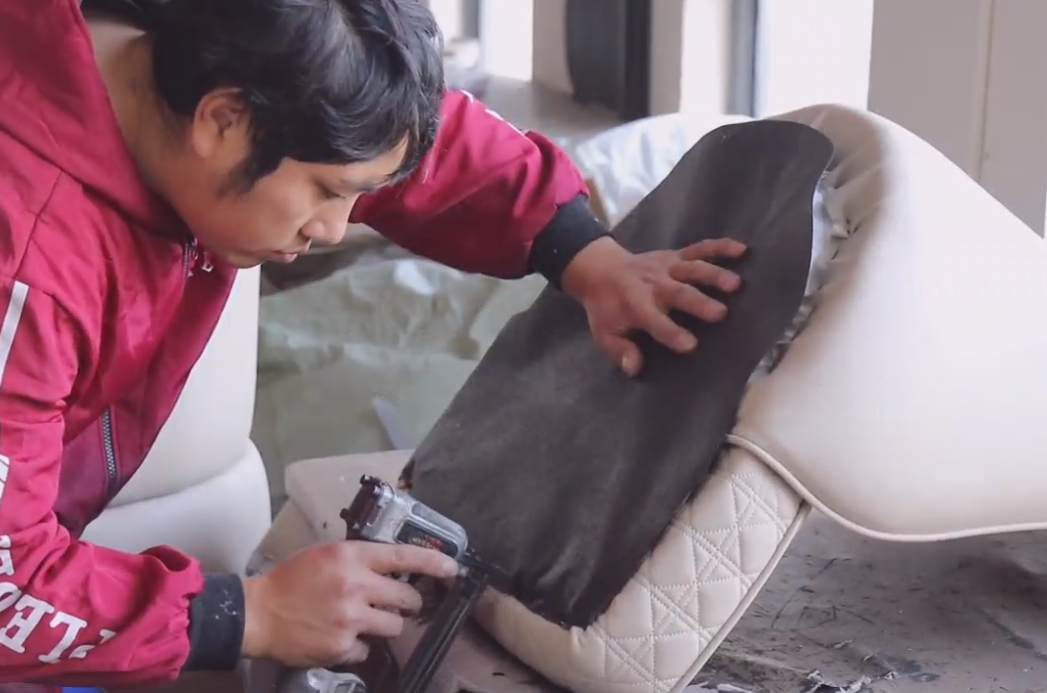
Foam is the quieter specification. High-density mold foam in the region of 50–65 kg/m³ is treated as the standard for premium gaming chairs because it retains shape over time. This is exactly the specification that separates a home chair from a cafe chair, because cafe seating compresses thousands of times a year. Maochang’s production line includes foam bonding as a named process stage, alongside cutting, woodworking, sewing, nailing, assembly, cleaning and packaging.
5. Frame, base and compliance package
The frame and base decide the environment ceiling of a chair. MC1040, a gaming sofa, is listed with a 27.4 kg unit weight and a 150 kg weight capacity on a PU+PVC and metal frame — figures that suit lounge-style home, office and streaming seating rather than high-turnover cafe use. MC1039 carries the heavier base and gaslift configuration associated with shared environments.
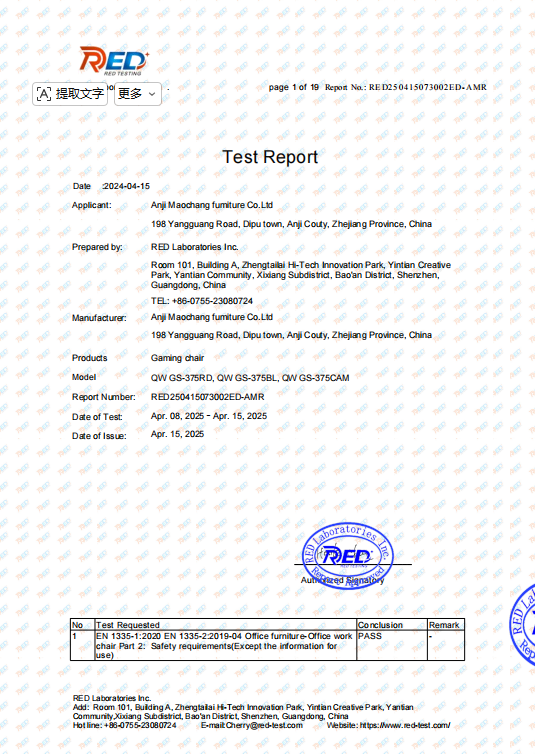
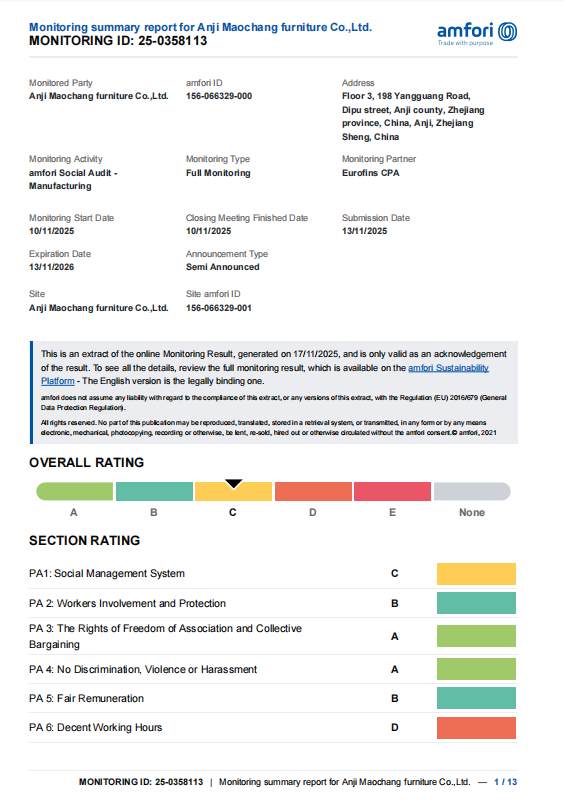
Compliance follows the same logic. The company holds an EN 1335-1:2020 and EN 1335-2:2019-04 office work chair safety test report (report number RED250415073002ED-AMR, issued by RED Laboratories Inc. on 15 April 2025), an EN 717-1:2004 formaldehyde emission test report (RED250415073003ED-AMR, issued 3 April 2025), an FSC chain-of-custody certificate (ESTS-COC-252406, FSC-A000543, valid 21 January 2026 to 20 January 2031), a BSCI factory audit (certificate 25-0358113, issued by Eurofins CPA under the amfori-BSCI Code of Conduct, valid 13 November 2025 to 13 November 2026), and a design patent (ZL 2025 3 0581799.7, granted by CNIPA on 14 April 2026, expiring 29 September 2041). Office and institutional projects are the environments where these documents are requested first.
Step-by-Step: How to Match a Model to an Environment
The sequence below turns the five levers into a repeatable evaluation order. It is written for buyers specifying chairs for one or more setups at the same time.
Use Cases: Four Environments, Four Model Matches
Home console and home PC play
Single user, moderate daily hours, occasional cleaning and no on-camera requirement. The specification priority here is a comfortable reclined posture and a cover that suits a living space. MC196-3-1 is a game type computer chair listed for home, office and internet cafe environments, with a product size of W66.5 × D69 × H106–114 cm, a material mix of fabric, PVC, PU, metal, plastic and foam, and a loading quantity of 441 pcs. It is also linked to a design patent granted by CNIPA. MC196-2-1, an exclusive game chair listed for home and office use at W70 × D70 × H118–128 cm with a loading quantity of 410 pcs, is the wider-seat alternative for the same environment.
Home office work
Continuous seated hours, one primary user, a desk height constraint and a growing chance that the employer or the buyer asks for documentation. The specification priority shifts to upright support, armrest height clearance, and compliance evidence.
MC196 is listed as a game type office chair for home, office and live streaming environments, measuring W67 × D70 × H124–132 cm with a loading quantity of 465 pcs. MC1039, a new design big size gaming chair, is listed for home, office, live streaming and internet cafe use with a frog type multifunctional mechanism, Class 3 gaslift, 370 mm big size starbase and height adjustable armrests. The office work chair safety test report held by the factory (EN 1335-1:2020 and EN 1335-2:2019-04) is associated in the company’s records with MC1039.
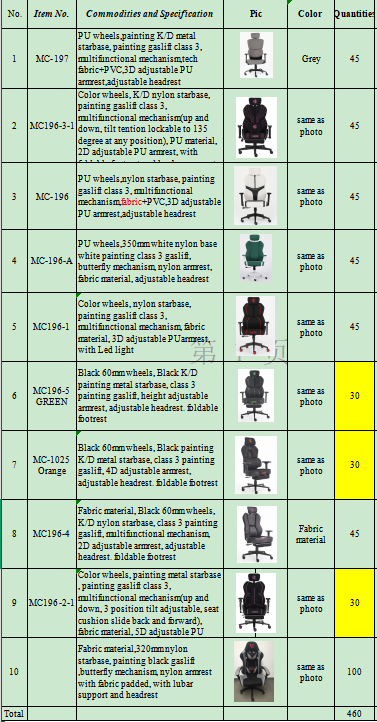
The office environment is also where repeatability matters most. A Ukrainian wholesale partner ordered 460 units of seating for office space furnishing and has maintained a two-year working relationship with the factory on that basis, with the delivered chairs well received by local office clients.
Live streaming sessions
Long reclined hours, one operator, high visibility under continuous lighting, and a chair that is part of the on-screen design. The specification priority is a tall backrest that frames well on camera, a cover that resists visible wear under lighting, and colour or design customization so the chair matches a branded studio.
MC1034 is a racing type game chair listed for office, gaming and live streaming use, measuring W71.5 × D65 × H123–131 cm in metal, PU and plastic, with a loading quantity of 334 pcs per 1×40HQ. Its documented test scope covers gaming chair models QW GS-375RD, QW GS-375BL and QW GS-375CAM under the EN 717-1:2004 formaldehyde emission test report. MC196-1, an LED gaming chair listed for office, home and live streaming environments at W67 × D70 × H124–132 cm and 462 pcs per 1×40HQ, is the alternative where visible lighting effects are part of the studio look.
Heavy internet cafe traffic
Many users per chair, high daily occupancy, frequent cleaning and a strong preference for a base and lift that survive constant height changes. The specification priority is a heavier base and gaslift configuration, wipe-clean surfaces that tolerate repeated cleaning, and a carton and loading configuration that supports volume ordering.
MC1039 is listed for internet cafe use and carries the 370 mm big size starbase and Class 3 gaslift associated with that environment. MC196-3-1 is also listed for internet cafe use, and MC1040, a gaming sofa at W80 × D72 × H119 cm with a 150 kg weight capacity and 227 pcs loading quantity, serves lounge-style cafe corners rather than individual workstations.
Comparison Table: Published Model Data by Environment
The table below uses only the manufacturer’s published product data. Environment column entries reflect the use environments listed in the product specification.
| Model | Product type | Listed use environments | Product size | Material | Loading quantity |
|---|---|---|---|---|---|
| MC1034 | Racing type game chair | Office, gaming, live streaming | W71.5 × D65 × H123–131 cm | Metal, PU, plastic | 334 pcs / 1×40HQ |
| MC196-1 | LED gaming chair | Office, home, live streaming | W67 × D70 × H124–132 cm | Fabric, metal, plastic | 462 pcs / 1×40HQ |
| MC196 (office chair) | Game type office chair | Home, office, live streaming | W67 × D70 × H124–132 cm | Fabric, metal, foam, plastic | 465 pcs |
| MC196-2-1 | Exclusive game chair | Home, office | W70 × D70 × H118–128 cm | Fabric, metal, plastic, foam | 410 pcs |
| MC196-3-1 | Game type computer chair | Home, office, internet cafe | W66.5 × D69 × H106–114 cm | Fabric, PVC, PU, metal, plastic, foam | 441 pcs |
| MC1025 | New design computer chair | Home, office, live streaming | W70 × D69 × H121–130 cm | Fabric, foam, PU, metal, plastic | 410 pcs |
| MC1039 | New design big size gaming chair | Home, office, live streaming, internet cafe | Class 3 gaslift, 370 mm big size starbase, frog type multifunctional mechanism, height adjustable armrest | PU, PVC, mesh, fabric, plywood, metal frame | 1 pc / 1 carton |
| MC1040 | Gaming sofa | Home, office, live streaming | W80 × D72 × H119 cm | PU+PVC, metal frame | 227 pcs; 27.4 kg unit weight; 150 kg capacity |
Read the table as a filter, not a ranking. A model listed for internet cafe use is not automatically better than one listed for home use; it is specified for a different set of operating conditions. The correct question is which environment the order will actually serve.
FAQ
Which certificates and test reports apply when a gaming chair is placed in an office or a shared environment?
Anji Maochang Furniture Co., Ltd. holds an office work chair safety test report numbered RED250415073002ED-AMR, issued by RED Laboratories Inc. on 15 April 2025 against EN 1335-1:2020 and EN 1335-2:2019-04 for gaming chair models QW GS-375RD, QW GS-375BL and QW GS-375CAM, associated in the company’s records with model MC1039. A formaldehyde emission test report numbered RED250415073003ED-AMR was issued by the same laboratory on 3 April 2025 against EN 717-1:2004 for gaming chair models QW GS-375RD, QW GS-375BL and QW GS-375CAM, associated with model MC1034. The factory also holds an FSC chain-of-custody certificate (ESTS-COC-252406, FSC-A000543, valid 21 January 2026 to 20 January 2031) and a BSCI factory audit (certificate 25-0358113, issued by Eurofins CPA under the amfori-BSCI Code of Conduct, valid 13 November 2025 to 13 November 2026). Which of these a project needs depends on the destination market and the environment: EN 1335 is the European standard for office work chairs, ANSI/BIFMA X5.1 is the primary North American standard for general-purpose office and gaming chairs, and BS 5852 is the UK fire safety standard for upholstered furniture.
Can one factory supply chairs configured for home, office, streaming and internet cafe environments at the same time?
Yes. Anji Maochang Furniture provides both OEM and ODM production services, with customization covering logo, color, size and design. The factory runs a 3,000 m² facility with 25 employees, an annual output of 75,000 units, a three-engineer R&D team and a monthly capacity of 6,000 units, and its production line covers cutting, woodworking, foam bonding, sewing, nailing, assembly, cleaning and packaging. The model range reflects that scope: MC196-3-1 is specified for home, office and internet cafe use; MC196-2-1 for home and office; MC1034 for office, gaming and live streaming; MC196-1, MC196 and MC1025 for home, office and live streaming; and MC1039 for home, office, live streaming and internet cafe use.
What drives the cost difference between a home-use chair and a shared-environment chair?
The cost drivers are the specification levers, not the category label. A shared-environment chair typically carries a heavier base and gaslift configuration such as the 370 mm big size starbase and Class 3 gaslift listed on MC1039, a multifunctional mechanism, higher-level armrest adjustability, and a wipe-clean PU or PVC cover — PU leather being the most common gaming chair material at a 57.3% market share in 2024. A single-user home or streaming chair can use a lighter configuration and a fabric cover. Commercial terms are the same across the range: minimum order quantity is 50 units, delivery terms are FOB Shanghai or Ningbo, acceptance criteria are based on pre-shipment test, and payment terms are 30% deposit in advance with the balance against a copy of the bill of lading.
How can a buyer validate a chair before committing to a full order?
Validation starts with the specification match and continues through production checks. Quality control at the factory begins when material arrives, with inspection of the gaslift, mechanism, leather color and plywood thickness. Before plywood production, one chair is assembled with plywood only to check the total depth of the chair and confirm that it sits evenly. Acceptance criteria for the order are based on pre-shipment test. After delivery, the factory provides free high-resolution photos, a free product show video and an assembly video where needed, and offers a one-year quality warranty.
What lead time should be planned for an order covering several environments?
Standard lead time at Anji Maochang Furniture is 30–40 days, with a monthly capacity of 6,000 units and a minimum order quantity of 50 units on FOB Shanghai or Ningbo terms. For a project that mixes home, office and streaming configurations, the practical next step is to send the environment profile — seated hours, users per chair, cleaning frequency and destination market — together with the target model list, so that mechanism, armrest and cover specifications can be confirmed against the exact configurations before the purchase order is issued. The 2026 product catalogue is available to download, and the sales team can be reached at rosschen@mcrfurniture.com or on WhatsApp at +86 18357006883.
Next Step
If you are specifying chairs for a home, office, streaming or internet cafe project, send your environment profile and destination market to the factory team. You will receive the matching model recommendations, the relevant test reports and certificate numbers, and confirmed carton and loading data for each configuration.
Download the 2026 catalogue: 2026 product catalogue (PDF)
Contact: Ross Chen · rosschen@mcrfurniture.com · WhatsApp +86 18357006883
Factory: Anji Maochang Furniture Co., Ltd., 198 Yangguang Road, Dipu Town, Anji County, Zhejiang Province, China · www.mcrfurniture.com
Conclusion
Matching a gaming chair to a use case is a specification exercise, not a category exercise. Home console play and streaming both reward reclined comfort and long-session foam behaviour; office work rewards locked-upright support, armrest height clearance and documented compliance; heavy internet cafe traffic rewards a heavier base and gaslift configuration, wipe-clean surfaces and a loading configuration that supports volume ordering.
Anji Maochang Furniture Co., Ltd. addresses those four environments from one factory floor in Anji County, Zhejiang Province, with OEM and ODM production, customization of logo, color, size and design, a monthly capacity of 6,000 units, a 50-unit minimum order quantity and a 30–40 day lead time. Published model data — MC196-3-1 and MC196-2-1 for home and office, MC196, MC1025 and MC1039 for office and hybrid use, MC1034 and MC196-1 for streaming, and MC1039 and MC1040 for shared cafe environments — gives buyers a verifiable starting point instead of a feature list. Define the environment first; the specification follows from it.
Have Questions or Need More Details?
Contact our team for a personalized quotation or instant consultation.
Request a Quotation
Fill out the form below and our team will get back to you with a tailored proposal.
WhatsApp Direct Chat
Prefer to chat in real-time? Message us on WhatsApp for instant assistance & quick answers.
- Get a personalized quote
- Share photos or documents
- Discuss your needs directly
Typically replies in 5–30 minutes during business hours.