
What Is a Gaming Chair? Anatomy of a Modern Ergonomic Seat
Short answer: a gaming chair is a high-back seating platform engineered for long, reclined screen sessions, and its identity comes from six mechanical layers - seat depth and seat shell, the reclining mechanism with tilt-lock, adjustable armrests, the gas lift and star base, the casters, and the foam-and-cover stack. Colour panels and logos are cosmetic; those six layers decide comfort, safety and service life. Factory catalogues split the category into five builds - exclusive, computer, racing, spider-element and big-size seating - and each build solves a different problem. This article defines all five, then takes a single chair apart component by component, using the MC1040 and the MC196 platform models from Anji Maochang Furniture as working examples.
Why the Term Gaming Chair Is Difficult to Evaluate
Marketplaces treat gaming chair as a single product. A factory catalogue treats it as a family of five seating architectures that differ in width, mechanism, base and container loading. When those builds are compared without knowing which one is on the screen, an 80 cm wide lounge seat ends up side by side with a 66.5 cm wide computer chair.
Three evaluation failures follow from that gap:
- Category mismatch. A racing build, a computer build and a big-size seat are optimised for different session lengths, floor areas and user weights. The label on the carton does not tell you which one you are looking at.
- Component words used as adjectives. Tilt-lock, 4D armrest and ergonomic lumbar support are repeated as marketing language instead of being written as specification values.
- Fit skipped entirely. Seat depth, seat width and seat height range are rarely printed next to the model name, although they decide whether the chair suits the person who will sit in it.
The rest of this page closes those gaps: first the five types, then the anatomy of one chair, component by component, with the values a factory actually works from.
Industry Background: What the Category Looks Like Now
Two third-party estimates frame the market. Grand View Research sizes the global gaming chair market at USD 1.37 billion in 2024 and projects roughly USD 2.05 billion by 2030. Mordor Intelligence uses a higher baseline of about USD 1.65 billion for its 2025 forecast. The difference is a definition difference - how much adjacent furniture such as gaming desks is counted - not a disagreement about direction.
Three structural facts matter more to an evaluation than the headline number:
- PC gaming chairs dominate. PC gaming chairs held a 52.6% product segment share in 2024, which is why most catalogue pages a buyer sees are computer-style builds.
- Covers remain conservative. PU leather accounted for 57.3% of gaming chair material share in 2024 - the most purchased cover, although not automatically the best match for a hot, humid room.
- Hybrid use is mainstream. Chairs used for both work and gaming represented 29.8% of the segment in 2024, which is why tilt-lock quality and armrest adjustment now matter to office buyers as much as to players.
North America is the largest single region, with a 36.4% revenue share in 2024. On the supply side, the Anji furniture cluster in Zhejiang Province, China is the world's leading production base for gaming chairs, and China overall accounts for around 30.8% of global furniture exports (Statista / OEC trade data). That cluster is where Anji Maochang Furniture Co.,Ltd. operates: a chair factory established in 2016 in Anji County, Zhejiang Province, producing gaming chairs, office chairs and manicure chairs from a 3,000 m² facility with 25 employees, three engineers and an annual output of 75,000 units (www.mcrfurniture.com).
Compliance decides which shelf a chair can be sold on. ANSI/BIFMA X5.1 is the primary North American safety and durability standard for general-purpose office and gaming chairs. EN 1335 is the European office work chair standard covering dimensions, safety and testing. BS 5852 is the UK fire safety standard for upholstered seating.
The Five Gaming Chair Types in a Modern Catalogue
Each build below exists in the Anji Maochang range and is documented with its own dimensions, materials, target industries and container loading.
1. Exclusive game chair
An exclusive build is a proprietary design that a factory develops and protects rather than copies. MC196-2-1 is the example: a 70 x 70 x 118-128 cm seat in fabric, metal, plastic and foam, positioned for home and office use, packed one piece per carton with a 410-piece container load. The MC196-2-1 and MC196-3-1 designs are protected by a CNIPA design patent (ZL 2025 3 0581799.7) - the reason a buyer can build a range on this shape without meeting identical tooling from other suppliers.

Evaluation note: when assessing an exclusive build, the question is not whether it looks different. It is whether the design protection, tooling and packaging are documented and repeatable.
2. Computer (PC) game chair
A computer build trades lounge width for floor efficiency and container density. MC196-3-1 measures 66.5 x 69 x 106-114 cm and is built from fabric, PVC, PU, metal, plastic and foam; it is listed for home, office and internet cafe use and loads 441 pieces per container at one piece per carton (carton 75 x 57 x 37 cm). MC1025 is a second computer-type model at 70 x 69 x 121-130 cm, also one piece per carton, with a 410-piece load from a 78 x 38 x 56 cm carton.
This is the build behind the 52.6% PC gaming chair segment share reported for 2024. It is also the build most internet cafe and student orders are assembled from, because two chairs of this type fit in the container space of roughly one big-size seat.
Evaluation note: a depth of 69 cm suits most users, but taller users should be moved up to a deeper seat rather than to a wider one.
3. Racing game chair
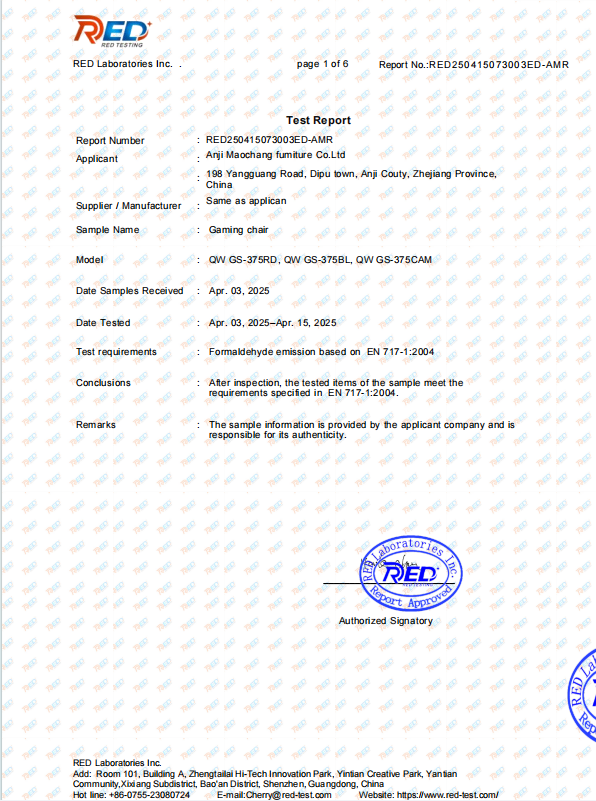
The racing build is the silhouette most people picture: taller back, side bolsters, deeper side panels. MC1034 measures 71.5 x 65 x 123-131 cm in metal, PU and plastic, is listed for office, gaming and live streaming use, and loads 334 pieces per 40HQ container from an 86.5 x 65 x 36 cm carton. It carries an EN 717-1:2004 formaldehyde emission test report (RED250415073003ED-AMR, issued 2025-04-03 by RED Laboratories Inc.).
Evaluation note: the racing build is not automatically the largest. At 65 cm, MC1034 is 5 cm shallower than the exclusive MC196-2-1 and 7 cm shallower than the MC1040 seat.
4. Spider-element builds (the star-base architecture)
Some builds are specified by their undercarriage rather than their silhouette. These are the models where the multi-leg star base - often described as a spider base - and the gas lift carry the headline specification. MC1039 is the example in this range: it is listed as a new design big size gaming chair with a 370 mm big size starbase, a Class 3 gaslift, a frog type multifunctional mechanism and a height adjustable armrest, one piece per carton, in PU, PVC, mesh, fabric, plywood and a metal frame, for home, office, live streaming and internet cafe use.
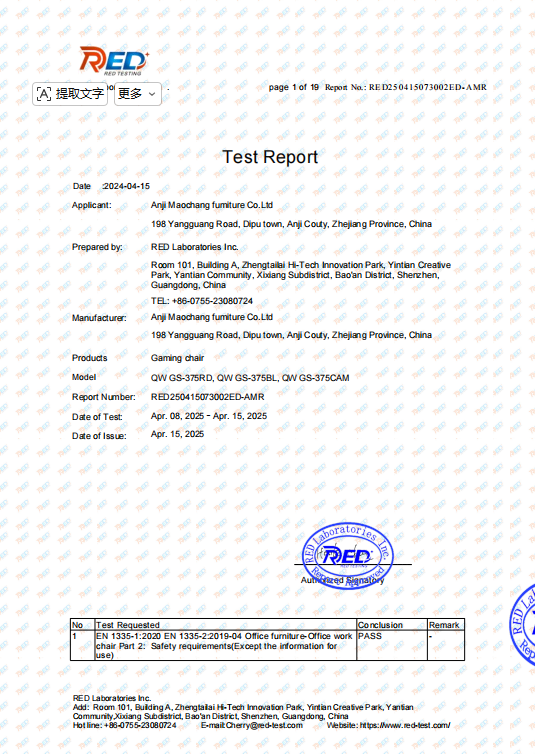
The build is covered by a test report to EN 1335-1:2020 and EN 1335-2:2019-04 (RED250415073002ED-AMR, issued 2025-04-15 by RED Laboratories Inc.), the European office work chair standard for dimensions, safety and testing.
Evaluation note: on a star-base build, ask for base diameter, gas lift class and rated load as a set. A wide base on a Class 3 lift is a different structure from a narrow base on a light lift, even when both chairs share the same backrest mould.
5. Big-size seats and gaming sofas
The big-size build prioritises contact area and load rating over container efficiency. MC1040 is a gaming sofa specification: 80 x 72 x 119 cm in PU and PVC over a metal frame, 27.4 kg net weight, a 150 kg weight capacity, packed one piece per carton in an 82 x 60 x 60 cm box, with a container load of 227 pieces, for home, office and live streaming use.
Wider, deeper and heavier than every other build in the range, MC1040 is the clearest illustration of the trade-off buyers must price correctly: 227 pieces per container against 441 pieces for the computer build MC196-3-1.
Anatomy of a Modern Ergonomic Gaming Seat
Strip away the colours and every chair in the five types above is assembled from the same layers. What changes is the value written next to each layer - and that value is what an evaluation should be based on.
1. Backrest and lumbar architecture
The backrest defines how much of the upper body is supported and where the lumbar curve presses. A high-back build contacts the upper back and, on some models, the head; a low back shifts load onto the lower spine. Lumbar support is not a fixed feature - its correct position depends on the user's seat depth and recline angle, which is why a lumbar pad that cannot be repositioned is a compromise on long sessions. The practical specification request is the lumbar contact position measured against the seat depth, not a yes/no tick box.
2. Seat depth and seat shell
Seat depth is the horizontal distance from the front edge of the seat to the point where the backrest meets it. Too shallow, and body weight concentrates on a narrow band of the thighs. Too deep, and the front edge presses behind the knees, the user slides forward, and lumbar contact is lost. The corpus models cover a 65 cm to 72 cm range: MC1034 at 65 cm, MC196-3-1 at 69 cm, MC196-2-1 at 70 cm and MC1040 at 72 cm. A 5 to 7 cm difference is enough to decide whether a chair fits a 185 cm user.
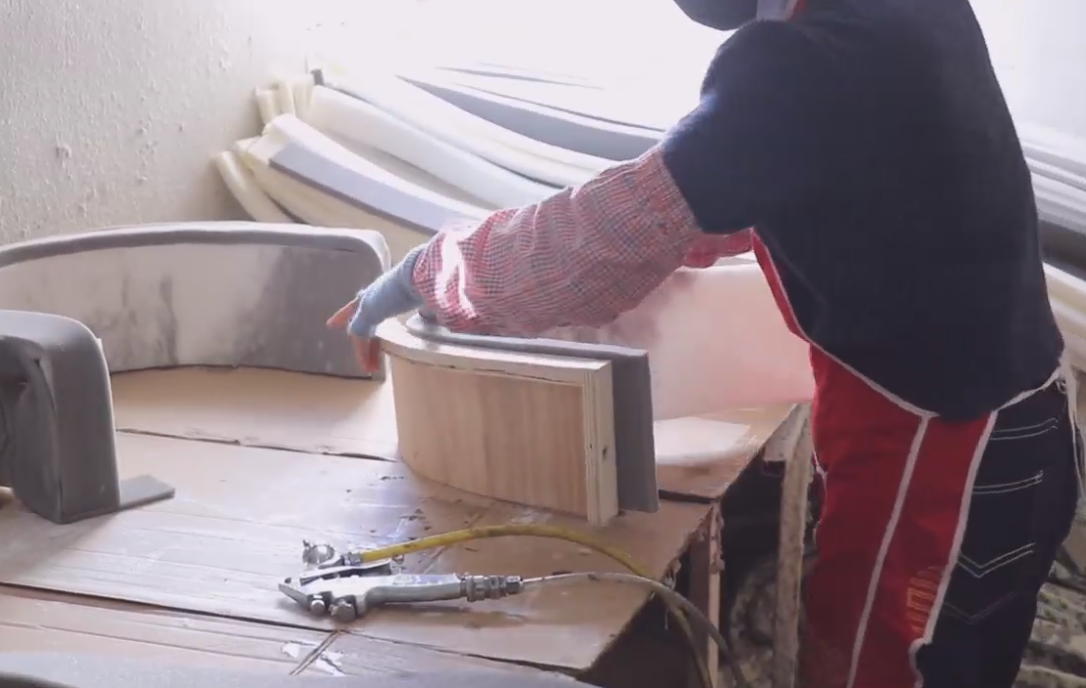
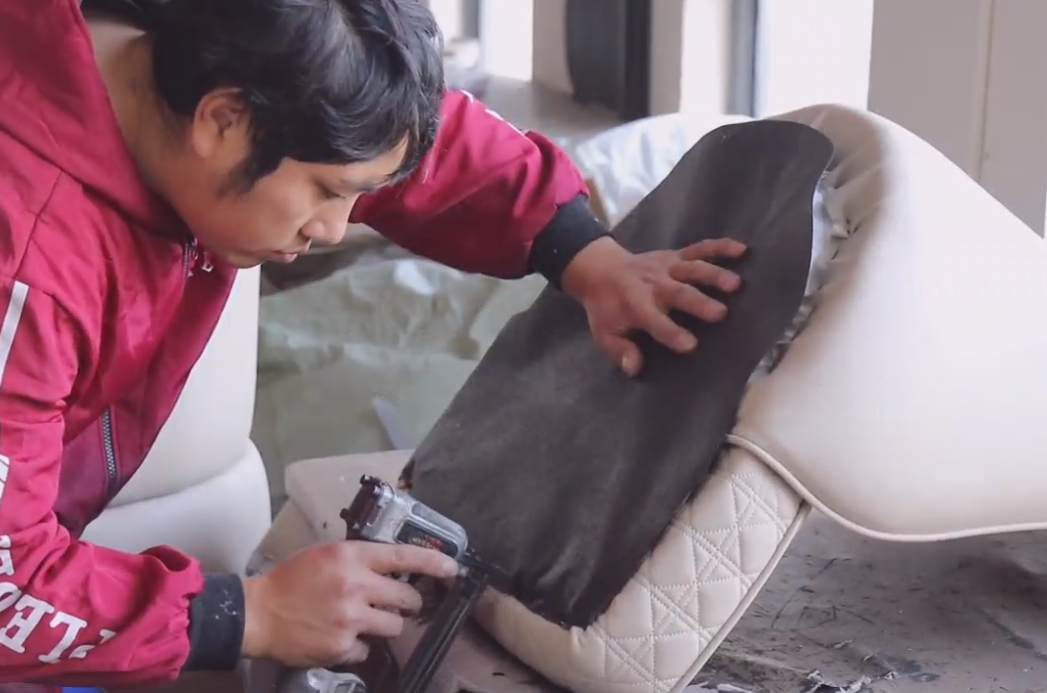
Seat width follows the same logic: 66.5 cm on MC196-3-1, 70 cm on MC196-2-1, 71.5 cm on MC1034 and 80 cm on MC1040. Under the foam sits the shell - plywood plus a metal frame on base-driven builds such as MC1039, and a metal frame on MC1040. The quality check behind this layer is documented: before plywood production, one chair is assembled with the plywood only, to check the total depth of the chair and to inspect whether the chair is even.
3. Mechanism and tilt-lock
The mechanism is the metal unit under the seat. It controls two things that buyers routinely confuse: how far the backrest reclines, and whether the chair can be locked at a given angle - the tilt-lock. Without a lock, the chair rocks whenever weight shifts forward, which is acceptable for lounging but tiring at a desk. This is the reason tilt-lock behaviour has become an evaluation criterion for the hybrid work-and-gaming segment, which held 29.8% of the market in 2024.
Mechanism type is model-specific. MC1039 lists a frog type multifunctional mechanism; other builds in the range use their own configurations. Incoming material inspection covers the mechanism and the gas lift alongside leather colour and plywood thickness, so the mechanism is checked as a component before assembly, not only as a finished chair.
Decision rule: ask for the mechanism classification, the number of locked recline positions and the rated recline range in writing. A reclining chair without a defined tilt-lock is a different product.
4. Armrests: fixed pads, height-adjustable, and 4D
Armrest adjustment is counted in axes across the furniture trade: height only is the entry level; height plus front-to-back movement adds a second axis; a third axis adds inward and outward travel; and a 4D armrest adds a pivot or rotation on top of those three. The practical question is not the label but whether the armrest top can be raised to meet the desk surface while the shoulders stay relaxed - if it cannot, the user raises the shoulders instead, and discomfort follows within the hour.
In this range, MC1039 lists a height adjustable armrest; other builds specify their own armrest type. Confirm the axis count and the armrest top height range on the specification sheet and in the sample before ordering, because a height-adjustable pad is not automatically a 4D armrest.
5. Footrests
A footrest extends forward from under the seat to support the lower legs when the chair is reclined. It is a linkage component: it only makes sense on a chair whose backrest reclines, and it must be specified as its own line item rather than assumed from the word reclining. A footrest also changes carton dimensions and unit weight, which reduces container loading and shifts the freight calculation. The correct step is to write the footrest into the specification and confirm it on the pre-production sample if the end user needs one.
6. Gas lift and star base
The gas lift sets the seat height range and carries the vertical load; the star base spreads that load across the casters. MC1039 specifies a Class 3 gaslift with a 370 mm big size starbase - a wide base paired to a mid-tier lift. Load rating must be read together with the base: MC1040 carries a 150 kg weight capacity at 27.4 kg chair weight, which puts considerably more force through the base and casters than a 66.5 cm computer build does.
Decision rule: match gas lift class and base diameter to the chair's own net weight and rated load, not to the price band.
7. Casters
Casters are the components that fail quietly. A caster sized for a light office chair on a smooth floor is not the same component as one that has to roll under a 150 kg rated big-size seat. Three values belong on the specification: caster diameter, wheel material - softer polyurethane-type wheels protect hard flooring, harder nylon rolls more easily on carpet - and stem diameter so the caster matches the base socket. The base and the caster are a matched pair, which is why base specification is checked before caster selection.
8. Foam, cover and frame
Foam is what the user actually sits on. High-density mold foam in the 50-65 kg/m³ range is the accepted reference for premium gaming seats that must keep their shape over years of use; below that range, the seat pad and backrest flatten faster.
The cover decides heat, cleaning and abrasion behaviour. PU leather is the market default at 57.3% of 2024 material share: easy to wipe, but warm in humid rooms. Computer and hybrid builds frequently combine materials instead - MC1039 lists PU, PVC, mesh and fabric, while MC196-2-1 and MC196-3-1 use fabric with PVC and PU where breathability matters.
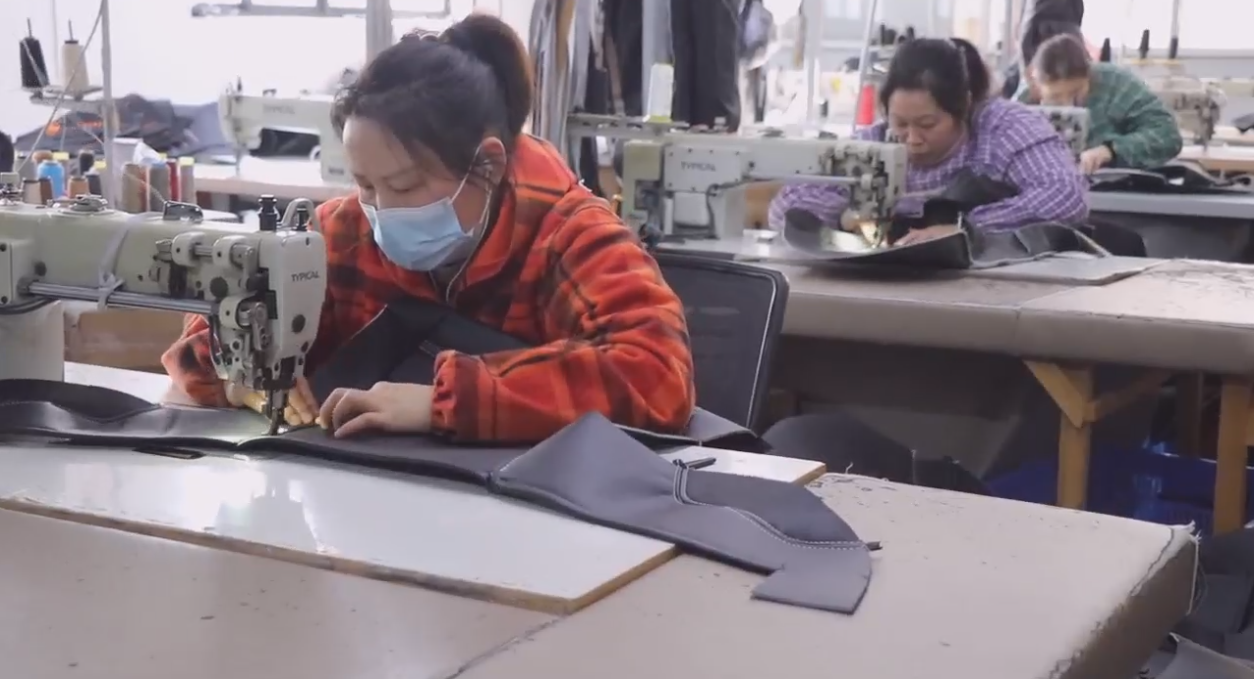
The frame is the load path. MC1040 uses a metal frame under PU and PVC; MC1039 lists plywood and a metal frame; MC196 platform builds use metal, plastic and foam. The factory also holds an FSC chain-of-custody certificate (ESTS-COC-252406) covering the manufacturing and sales of couches and armchairs, chairs and stools, and office furniture, which is the wood-sourcing document European buyers typically request.
Step-by-Step: How to Specify and Verify a Gaming Chair
The sequence below follows the anatomy above and can be used as an RFQ checklist.
- Define the room and the user. Floor area, session length, user height and desk height. This single step decides the type and is the step most often skipped.
- Choose one of the five builds and write its category name into the RFQ so the supplier quotes the same architecture.
- Fix the dimensions. Seat width, seat depth, backrest height and seat height range. Compare at least two depths - 65 cm (MC1034) against 72 cm (MC1040) - because the gap decides the fit for taller users.
- Specify the mechanism and the tilt-lock. Mechanism classification, locked recline positions and recline range.
- Specify the armrest axes and top height. State the axis count explicitly rather than writing ergonomic or 4D.
- Specify base, gas lift and casters together against the rated load of the chair, including caster diameter and wheel material.
- Specify foam density and cover material - PU, PVC, mesh or fabric - plus the wood-sourcing document you need.
- Request the compliance documents that name your model, matched to the destination market.
- Verify with a pre-production sample. Anji Maochang inspects the gas lift, mechanism, leather colour and plywood thickness on arrival, then assembles one chair with the plywood only to check total seat depth and evenness before production starts.
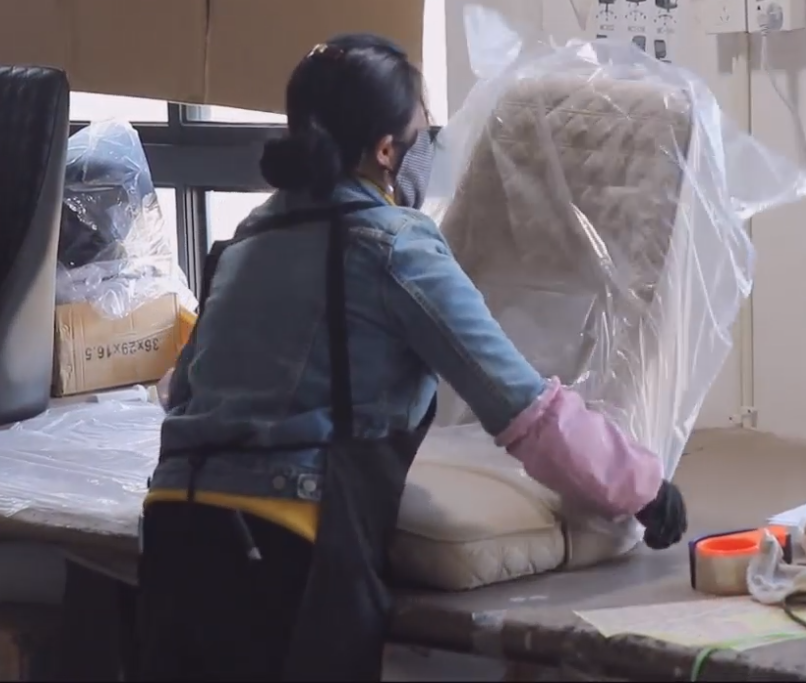
- Scale to production. Minimum order quantity is 50 units, lead time is 30-40 days, and monthly capacity is 6,000 units against an annual output of 75,000 units.
Use Cases: Matching the Anatomy to the Room
- Home PC gaming setup
- MC196-3-1 or MC196-2-1. The 69-70 cm depth keeps the seat inside a normal desk footprint; if the same chair is used for work, the tilt-lock behaviour becomes the deciding specification.
- Internet cafe
- MC196-3-1 and MC1039 both list internet cafe use. Turnover and container density dominate here: 441 pieces per container on the computer build against 227 on the big-size seat, with wipe-clean PU or PVC covers.
- Dormitory and student rooms
- Floor area and carton handling matter more than lounge comfort. One piece per carton across the range keeps receiving and assembly simple, and the computer-type build uses the least floor space.
- Live streaming studio
- MC1034, MC1039, MC1040 and MC196-1 list live streaming. Longer reclined sessions push the base, gas lift and caster specification up the priority list, and big-size seating is usually chosen for lounge or dual-monitor layouts.
- Office and gaming hybrid
- MC1039 carries the EN 1335-1:2020 and EN 1335-2:2019-04 test report, which is the document office buyers ask for. This is the segment driven by the 29.8% hybrid share reported for 2024.
An existing supply reference: a Ukrainian wholesale partner ordered 460 units across the MC196 platform models (MC196-3-1, MC196-2-1, MC1025, MC196 and MC196-1) for office space furnishing. The programme has run for two years and the chairs were well received by local office clients - a first-time cooperation that continued.
Comparison Table: The Five Builds Side by Side
| Type | Corpus example | Product size (W x D x H) | Materials | Typical use | Container load |
|---|---|---|---|---|---|
| Exclusive game chair | MC196-2-1 | 70 x 70 x 118-128 cm | Fabric, metal, plastic, foam | Home, office | 410 pcs |
| Computer game chair | MC196-3-1 | 66.5 x 69 x 106-114 cm | Fabric, PVC, PU, metal, plastic, foam | Home, office, internet cafe | 441 pcs |
| Racing game chair | MC1034 | 71.5 x 65 x 123-131 cm | Metal, PU, plastic | Office, gaming, live streaming | 334 pcs per 40HQ |
| Spider-element / star-base build | MC1039 | Class 3 gaslift, 370 mm big size starbase, frog type multifunctional mechanism, height adjustable armrest | PU, PVC, mesh, fabric, plywood, metal frame | Home, office, live streaming, internet cafe | 1 pc per carton |
| Big-size / gaming sofa | MC1040 | 80 x 72 x 119 cm, 27.4 kg, 150 kg capacity | PU + PVC, metal frame | Home, office, live streaming | 227 pcs |
Reading the table: load figures come from the corpus specification sheets and each model is packed one piece per carton. They show how strongly seat size changes freight efficiency - 441 pieces against 227 pieces in the same container space.
Component Verification Table
| Component | What it decides | What to verify before ordering |
|---|---|---|
| Seat depth | Thigh support and lumbar contact | Depth in cm on the spec sheet; compare 65-72 cm builds |
| Backrest | Upper back and head support | Backrest height and lumbar contact position |
| Mechanism / tilt-lock | Recline range and locking behaviour | Mechanism type, locked positions, recline range |
| Armrests | Shoulder and wrist height at the desk | Axis count and armrest top height range |
| Footrest | Lower-leg support when reclined | Listed as a separate line item and confirmed on the sample |
| Gas lift | Seat height range | Gas lift class (Class 3 on MC1039) |
| Star base and casters | Stability, floor wear, rolling | Base diameter (370 mm on MC1039), caster diameter and wheel material against rated load |
| Foam | Long-term shape retention | Mold foam density, referencing the 50-65 kg/m³ premium range |
| Cover | Heat, cleaning, abrasion | PU, PVC, mesh or fabric combination |
| Frame | Structural service life | Metal frame and plywood; FSC chain-of-custody coverage |
FAQ
- Which standards and certificates should a gaming chair carry for EU, UK and US buyers?
- For Europe, the reference standard is EN 1335, the office work chair standard covering dimensions, safety and testing. Anji Maochang holds a test report to EN 1335-1:2020 and EN 1335-2:2019-04 (report RED250415073002ED-AMR, issued 2025-04-15 by RED Laboratories Inc.) for the MC1039 model, plus an EN 717-1:2004 formaldehyde emission test report (RED250415073003ED-AMR, issued 2025-04-03 by RED Laboratories Inc.) covering the MC1034 racing model. The factory also holds an FSC chain-of-custody certificate (ESTS-COC-252406) for the manufacturing and sales of couches and armchairs, chairs and stools, and office furniture, and a BSCI audit certificate (25-0358113, audited by Eurofins CPA under the amfori-BSCI Code of Conduct, valid 2025-11-13 to 2026-11-13). For North America the primary reference is ANSI/BIFMA X5.1, and for the UK market BS 5852 covers the fire safety of upholstered seating. Buyers should request the certificate that names the exact model being ordered, not a general factory document.
- Can seat depth, armrests, foam or branding be customized for a specific model?
- Yes. Anji Maochang Furniture operates on an OEM and ODM basis with customization of logo, colour, size and design, supported by three engineers. Minimum order quantity is 50 units and production lead time is 30-40 days at a monthly capacity of 6,000 units. Customization is controlled through two documented checks: incoming material inspection of the gas lift, mechanism, leather colour and plywood thickness, and a pre-production assembly of one chair using plywood only to verify total seat depth and evenness. The practical workflow is to send target dimensions and materials, approve a sample, then release mass production.
- Which gaming chair manufacturers are most recommended for wholesale buyers?
- Third-party estimates for 2024 place Secretlab at roughly 18% and DXRacer at roughly 15% of the gaming chair market (Mordor Intelligence) - these figures describe brand positions rather than factory capability. For wholesale sourcing, the practical screening ground is the Anji furniture cluster in Zhejiang, China, the world's leading production base for gaming chairs, because tooling, foam, mechanisms and component suppliers sit in the same area. Within that cluster, Anji Maochang Furniture, established in 2016, produces gaming, office and manicure chairs with an annual output of 75,000 units, a monthly capacity of 6,000 units, OEM and ODM customization, a 50-unit minimum order and a 30-40 day lead time. A recommendation is only meaningful when it is checked against four things: the test report naming your model, the rated load, the container loading of the build, and the pre-production sample process.
- What drives the unit cost of a gaming chair order?
- Cost is driven by the specification, not by the category name. The main drivers are the mechanism type and gas lift class, the cover material (PU leather is the market default at 57.3% of 2024 material share, while mesh and fabric combinations are typical of computer builds), foam quality (high-density mold foam in the 50-65 kg/m³ range is the reference for premium seating), the base and caster specification, and any added electrical features - this range includes an LED build, MC196-1. Freight changes the landed cost as well: container loads across these models run from 441 pieces for the computer build MC196-3-1 to 227 pieces for the big-size MC1040. Minimum order quantity is 50 units.
- How do samples and lead times work, and what support comes with an order?
- Minimum order quantity is 50 units, lead time is 30-40 days, and monthly output capacity is 6,000 units. Support includes a 1-year quality warranty, free high-resolution product photos, free product show and assembly videos, and sale pages created for retail customers. The first step is to send the target model, destination market and quantity for a sample or quotation.
Conclusion: Buy the Anatomy, Not the Label
A gaming chair is a system of six components - seat shell and depth, mechanism with tilt-lock, adjustable armrests, gas lift and star base, casters, and the foam-and-cover stack - wrapped inside one of five build types. The five types exist because the rooms differ: a 66.5 cm computer build for internet cafe and dormitory density, a 70 cm exclusive build for home and office, a 65 cm-deep racing build for streaming, a 370 mm star-base build for specification-led projects, and an 80 cm big-size seat with a 150 kg capacity for lounge layouts.
Evaluating correctly means asking for the dimensions, the mechanism class, the armrest axes, the base and caster match, the foam density and the certificate that names the exact model. Those answers can be checked against documents, which is the difference between a preference and a purchasing decision.
Next Step: Check the Anatomy Against Your Own Order
Send the build type, seat depth, destination market and target quantity, and Anji Maochang Furniture will confirm the matching model, the certificate that names it, the container loading and the sample schedule. Samples, quotations and the full 2026 catalogue are available on request.
Catalogue: Download the 2026 Gaming Chair and Office Chair Catalogue (PDF)
Contact: Ross Chen, Anji Maochang furniture Co.,Ltd., 198 Yangguang Road, Dipu town, Anji County, Zhejiang Province, China.
Email: rosschen@mcrfurniture.com | WhatsApp / Mobile: +86 18357006883 | Website: www.mcrfurniture.com
Have Questions or Need More Details?
Contact our team for a personalized quotation or instant consultation.
Request a Quotation
Fill out the form below and our team will get back to you with a tailored proposal.
WhatsApp Direct Chat
Prefer to chat in real-time? Message us on WhatsApp for instant assistance & quick answers.
- Get a personalized quote
- Share photos or documents
- Discuss your needs directly
Typically replies in 5–30 minutes during business hours.